Victory of the Hive
May 1st is rapidly approaching and winter is relaxing its grip. It’s a blessed time in the northern hemisphere, especially for gardeners who can finally begin planting in earnest. It’s the season of the plough.
Dates
Gregorian: April 30th to May 1st (International Workers’ Day)
But May 1st isn’t just a significant time for growing food, nor only in pagan culture. It’s also International Worker’s Day, a time to reflect and act on the sacrifices working-class people have made to earn basic human rights from an oppressive ruling class. Though this holiday has been watered down in North America, instead replaced with a relaxed “Labour Day” in September, its roots are re-emerging during a time of rising income inequality.
It’s at this intersection that Nodons makes himself known to us in many forms.
Alternatively, the agricultural aspects can be celebrated at different times to fit with one’s practice:
Luni–solar: The second full moon after the spring equinox.
Coligny: 7th or 8th of Cantlos (first quarter/spring start)
Gregorian: May 1st (Northern Hemisphere) or November 1st (Southern Hemisphere)
Inspiration
The Warrior
Social justice cultus is an inherent part of Sepânioi Rotî’s theology, so the inclusion of International Worker’s Day into our calendar of holidays made perfect sense. This is a day of action. These days many of us are fighting against having our jobs replaced by automation, AI, without any benefit to the workers. This battle was fought before by a group of textile workers who wanted to continue working from home and earning a living wage, but were replaced by expensive machines that capitalists could pay children to operate for pennies a day. This group took up the name of a local hero, one whose name was inspired by an ancient king. They were the Luddites.
It’s important to note that the linguistic connection between the Luddites and Nodons isn’t a straight line, since Ludd Llaw Eraint may have been a different figure from the King Ludd who inspired the naming of folk hero Ned Ludd; however, just because the name spread and split into different stories doesn’t reduce the connection to Nodons, the earlier Brittonic deity whose name lived on in legend. In Sepânioi Roti we believe that deities are not fixed in time. Religion and culture are closely intertwined, so as the name of a deity echoes through time, so-to does the deity’s image change with the times. Was Nodons originally a god of the working class? We have no idea. We know that he was worshiped atop an iron mine, so miners and artisans likely prayed to him – workers who are still treated horribly to this day, no matter how modernized. We know that he was worshiped by soldiers, shipped from across the Roman empire to the furthest borders – not unlike so many of us who have traveled far from home to earn a living. We know that his cognates were each missing a hand, replaced by a silvery one – not unlike the millions of workers who have lost limbs on the job. Why shouldn’t Nodons be the god of the working class?
The Ploughman
In much of the world, spring is known for rains. These are a powerful force, a force that brings a grey world back to life – and sometimes a dangerous one as river banks threaten to burst, but a source of fertility nonetheless. Though the rains come from above, Gallo-Brittonic polytheism is nothing if not muddled in its distinction between the ouranic and chthonic. Nodons, cloud bringer, king of the seas above Dubnos, sends us new life from the depths. The cycle of water in our world keeps the cycle of seasons turning, and we give Nodons thanks for the health and fertility his rains bring. In fact, French settlers in North America were known for collecting the first rains of May (especially on the 1st) for its healing properties. What better time to show our gratitude to Nodons?
This timing may have a historical basis. Nodons is commonly thought to be cognate to Lludd Llaw Eraint (“Nudd of the Silver Hand”), a king from Welsh myth who captured 2 dragons whose battling was causing strife to his lands (and many other feats). He did so, in part, by burying a cauldron of mead in the center of Britain and luring the dragons in on the eve of May Day. This imagery brings to mind the Gundestrup Cauldron, and a statue of British Mars holding 2 horned serpents. The story also has a connection to another holiday around the same time, the Feast of St George on April 25th. St George was a Middle-Eastern saint who was brought back to Britain during the Crusades and is now known as the slayer of dragons. Most importantly, he was said to have slain his dragon on a hill near Oxford, which is also the location of this mead ritual performed by Lludd…
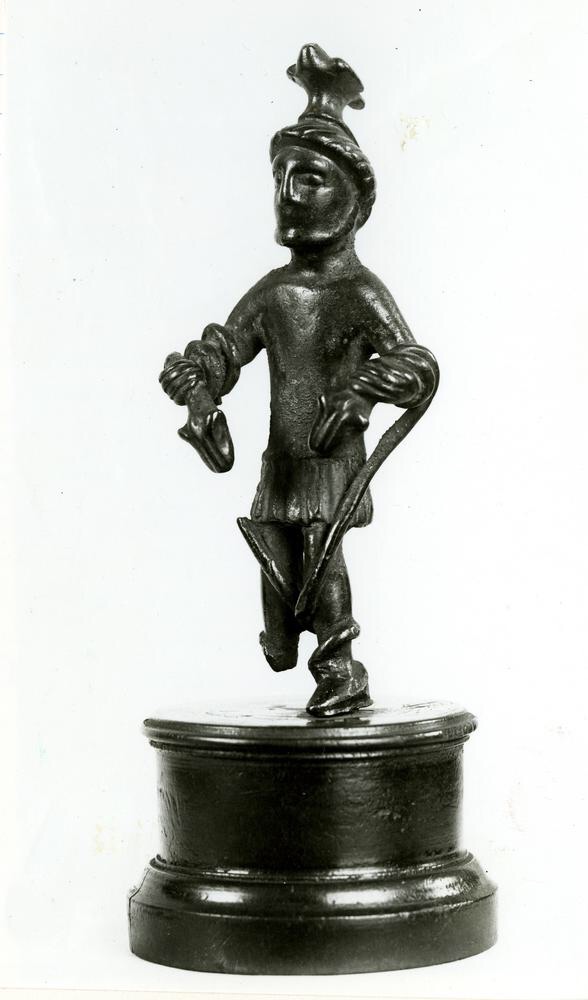
Looking into St George, there may be an etymological link to “plougman”. Ambactonos, the Brittonic “divine plougman” god, is a good fit for spring; the hunter and the ploughman are divine opposites, the former reaching their peak 6 months later. So here we have a dragon-slaying holiday with possible ties to ploughs at a time when seeds are planted, with mythical ties to burying mead and restoring life to the land.
Activities
This holiday has 2 aspects: that of the warrior and that of the plough. These are blended into one, with a ritual pouring mead (or wine, or nutrients) into the ground so that the winter can be sealed away (note: do your own research on when/how to use wine as a fertilizer). The next day is a time for action, supporting workers however you see fit, so Nodons can be petitioned for strength the night before. You can find the script for a ritual here.
Additionally, collecting the first rains of May can provide for strong blessed water.
Theological Importance
Nodons finishes his battles against the Anguipeds, locking away the last of them beneath his kingdom. He melts down his iron hand into a plough and finishes the work he started: restoring life to the land scourged by his enemies.
We do the same, working together to fight for our basic human rights. To build, we plant food to share with neighbours and native wildflowers for pollinators, or any other action that helps restore the land.
Offerings
Mead (or wine or nutrients), protesting, hand-shaped idols, rain (collected and blessed beforehand).
 Sepânioi Rotî